Some OSRS traders ignore ordinary commodity flips and speculate on Jagex’s development pipeline instead. They gather on trading forums and Discords, take positions in illiquid items, and accept much higher risk for the chance of a large payout.
How update speculation works
Speculative trading in OSRS means reading developer blogs, summit announcements, poll questions, and in-game lore. Traders try to build positions in illiquid items before an update confirms that the items will have a use.
The “buy the rumor, sell the news” cycle
The cycle is familiar from other markets: buy before the news, then sell when the news is public. In OSRS, the pattern often looks like this:
- Accumulation (the rumor): “Whales” build positions near an asset’s historical floor without creating obvious volume spikes.
- Retail FOMO: Traders publish the thesis on Reddit and YouTube, and more casual players buy in. The extra demand pushes the price higher.
- Distribution (selling the news): Before the update goes live, early buyers sell into the new demand.
- The post-update crash: After the update, more holders may sell at once. If real player demand is smaller than the stored supply, the price falls.
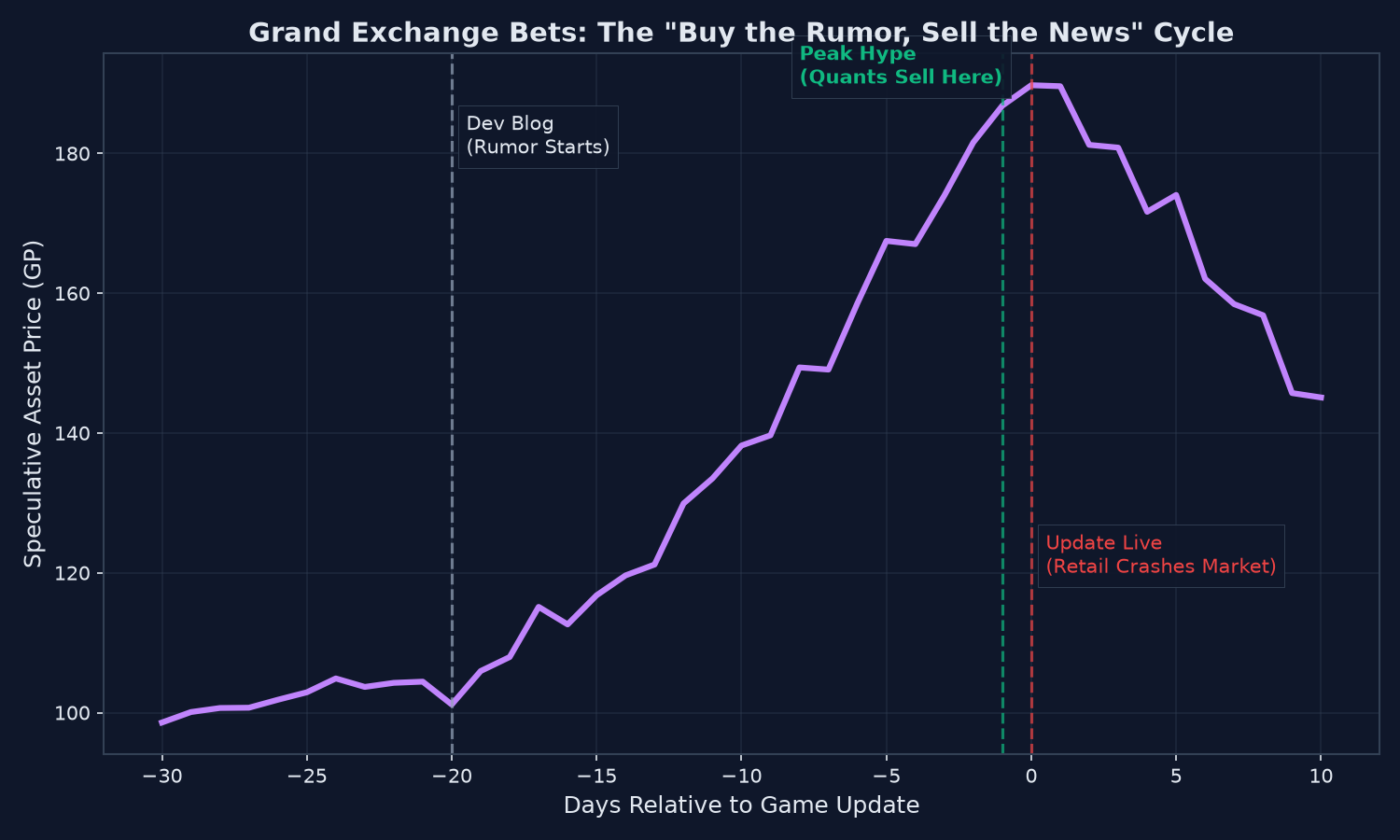
Smart money exits before the update goes live. Retail buys the peak and holds the crash.
Examples of speculative trading
These trades can produce large gains, but the losses can be just as large.
- The Raids 4 crush thesis: Historically, each major raid leans heavily into a specific combat style, and the “crush” style had long been neglected. Based on this, speculators theorized a future raid would feature a crush megarare or require heavy defense reduction. Smart money accumulated Inquisitor’s armor at all-time lows well before any official developer announcement, riding the set to a large multiple on pure speculative positioning and retail hype.
- The Elder Maul renaissance: Considered “dead content” and languishing at a fraction of its potential value, speculators hoarded this megarare betting on an eventual developer intervention. When Jagex finally announced a defense-reducing special attack buff, the asset surged, yielding diamond-handed investors an outsized return.
- The contagion risk of niche speculation: Speculation carries unhedgeable idiosyncratic risk. Traders have repeatedly bet on ultra-rare drops becoming valuable inputs for a future skill or update, only to watch the price crash when the actual utility turned out to be heavily bottlenecked by a different, more limiting resource. A technically rare item can still become functionally worthless if its assumed use case never materializes.
The practical rule is simple: use the data, follow Jagex’s stated direction, and decide when to exit before the update is public.
Related reading: 3rd Age After the GE Update is a case study in this cycle, and Reading the OSRS Market covers the fundamentals behind these moves.