The Grand Exchange (GE) is the main marketplace in Old School RuneScape. It matches buyers and sellers, but its hidden order book means the displayed prices do not tell you everything. If you want to move beyond “buy low, sell high,” you need to check the numbers behind each trade.
The order book is hidden. Buyers and sellers submit limit orders without seeing the current bid-ask spread or pending trades. That makes liquidity, margin, and tax calculations part of every serious flip.
The math of margin checks
Because the order book is hidden, traders use “margin checking” to find the prices a trade can clear at. Third-party trackers are useful, but they can be delayed by about 5 minutes. To check the current margin, cross the spread yourself:
- Place a buy offer at
+5%over the active trading price to force an instant purchase, revealing the current lowest ask. - Immediately sell that same item at
-5%to reveal the current highest bid. - The differential between these execution prices is your gross margin.
Gross margin is not take-home profit. Jagex charges a 2% transaction tax to curb inflation. The tax applies to items over 100 GP and is capped at 5,000,000 GP per transaction.
Calculate net profit after tax:
net profit = sell price − buy price − min(floor(sell price × 0.02), 5,000,000)
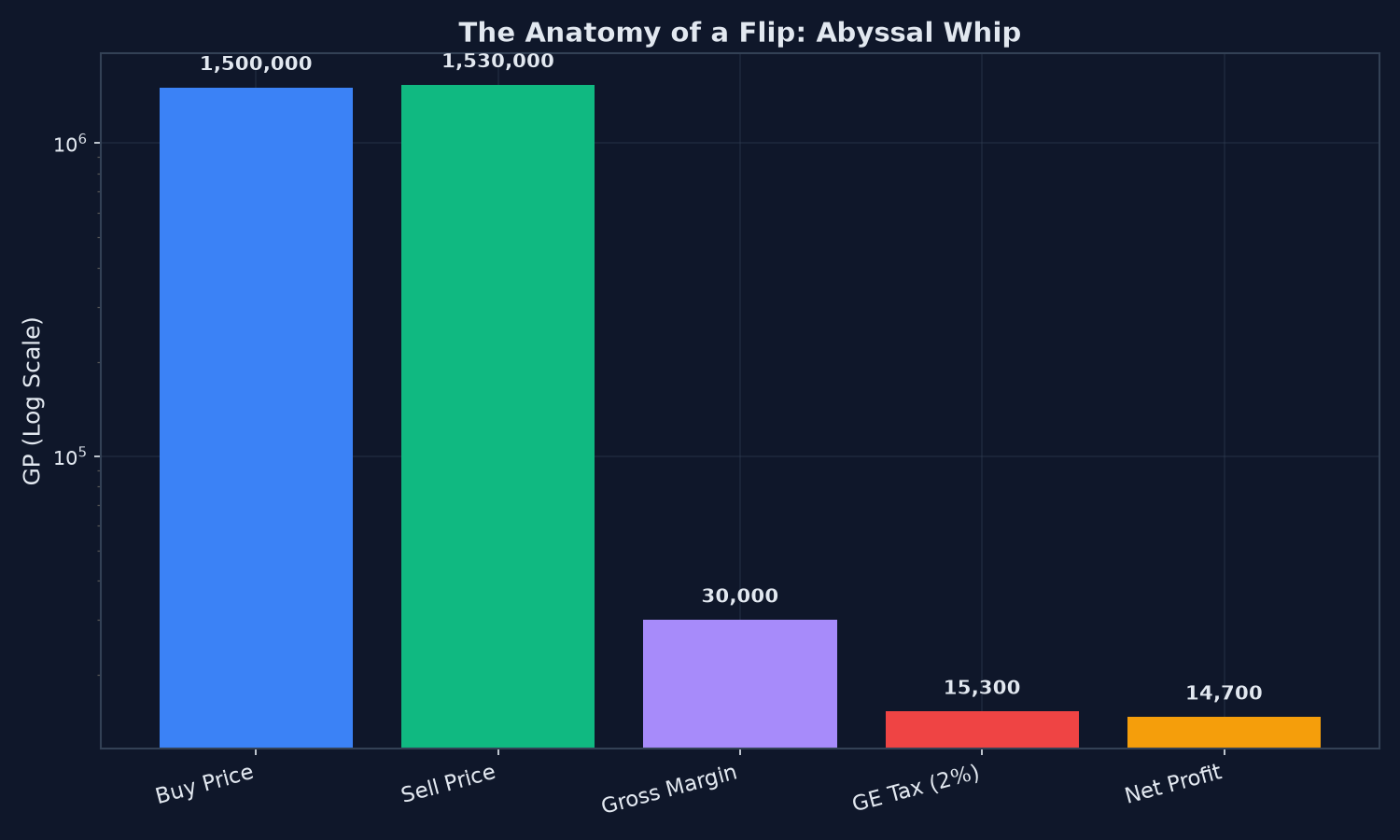
Subtract the tax before deciding whether a margin is worth your capital.
High-volume vs. low-volume flipping
Choose the type of flip based on your available capital and how long you can leave it in a trade.
- High-volume, low-margin commodities: Elemental runes, consumables, and raw skilling materials such as sharks and potions trade in large numbers with tight spreads. With a 10M to 100M GP bank, these can form the core of a flipping routine. Strict 4-hour buy limits cap the profit, but regular demand usually makes the trades easier to exit.
- Low-volume, high-margin megarares: End-game PvM equipment such as the Twisted Bow and Scythe of Vitur can produce margins worth tens of millions of GP. These trades need substantial capital (1B+ GP) and carry wider price swings, longer holds, and frequent 1-GP undercuts from other merchants.
Track your data and avoid common traps
The standard client and manual spreadsheets offer limited history. A local setup can pull community data endpoints, such as the Wiki real-time pricing API, into one place so you can compare trade timing and price history.
When starting out, respect the GE’s 4-hour buy limits and watch for “false margins” on charts. If an item such as Yew Logs suddenly shows a very wide margin, treat it as a possible manipulation signal. Look for repeated price movement rather than one vertical drop.
Related reading: Reading the OSRS Market covers price trends before you commit capital, and Grand Exchange Bets covers manipulation and hype cycles.